On this page
- How does heat treatment control the mechanical properties of steel?
- What are the main microstructures in carbon and low-alloy steel?
- What does annealing do to steel?
- What does normalizing steel achieve?
- What happens during quenching and what are its effects on steel properties?
- What is tempering and why is it necessary after quenching?
- How should I select and specify a heat treatment process on an engineering drawing?
- Key takeaways

How does heat treatment control the mechanical properties of steel?#
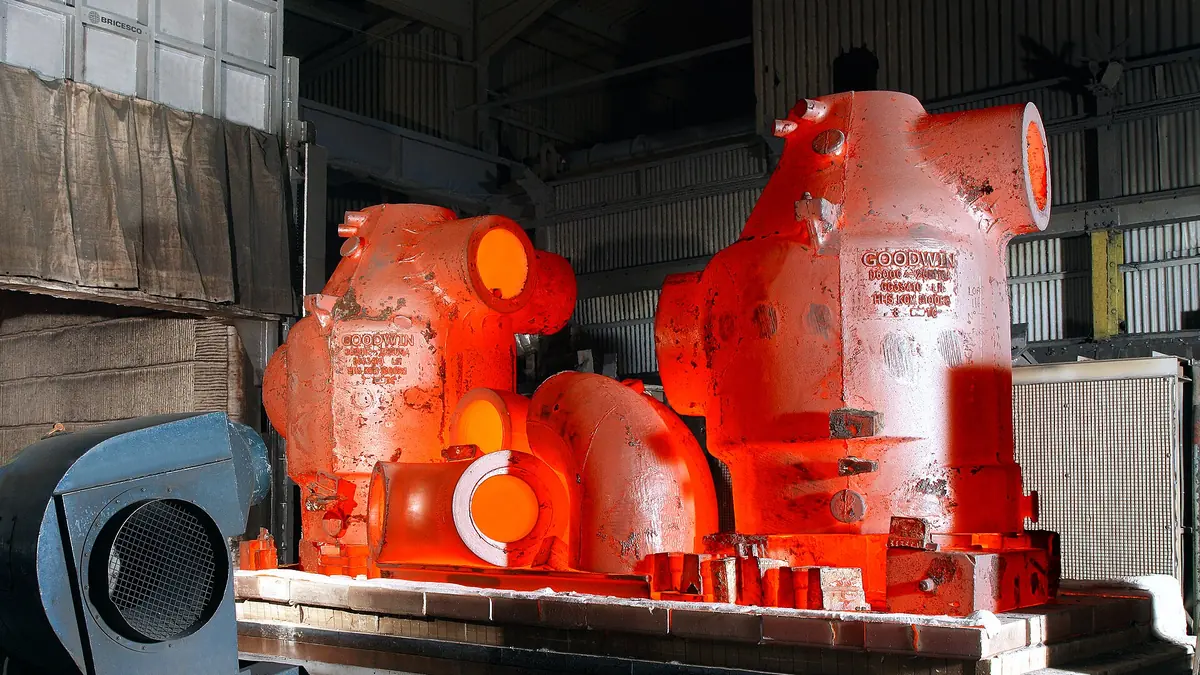
Steel heat treatment controls mechanical properties such as strength, hardness, toughness, and machinability by changing the microstructure through a controlled cycle of heating, holding, and cooling. The key process variables are peak temperature, soak time, and cooling rate, which determine whether the steel transforms to ferrite, pearlite, bainite, or martensite.
For carbon and low-alloy steels, the transformation temperatures that matter are the A1, A3, and Acm lines shown on the iron-carbon phase diagram. To use them as a process map, see How to Read an Iron-Carbon Phase Diagram.
Heating above the upper transformation temperature, usually into the austenite range, allows carbon and alloying elements to dissolve and the prior room-temperature structure to be largely erased. Cooling rate then determines whether the steel transforms to coarse ferrite and pearlite, fine ferrite and pearlite, bainite, or martensite.
The same steel can be soft and easy to machine, moderately strong and tough, or hard and wear resistant depending only on the thermal route. That is why a drawing that says only “heat treat” is not enough: the specification must identify the process and the required final condition.
What are the main microstructures in carbon and low-alloy steel?#
The four primary room-temperature microstructures in carbon and low-alloy steel are ferrite (soft, ductile body-centered cubic iron), pearlite (a lamellar mixture of ferrite and cementite), bainite (an intermediate structure offering a balance of strength and toughness), and martensite (a hard, brittle carbon-supersaturated body-centered tetragonal structure formed by fast cooling).
Microstructure, not just chemistry, dictates the final mechanical properties. The four main room-temperature structures in carbon and low-alloy steel are:
- Ferrite: low-carbon body-centered cubic iron. It is soft, ductile, and magnetic, and it forms during slow cooling.
- Pearlite: a lamellar mixture of ferrite and cementite, also called iron carbide. It is stronger than ferrite and forms at the eutectoid composition. Fine pearlite from faster cooling is harder than coarse pearlite from annealing.
- Bainite: an intermediate structure formed below the pearlite range and above the martensite start temperature. It offers a practical combination of strength and toughness and can be produced by controlled cooling or isothermal treatment.
- Martensite: a carbon-supersaturated body-centered tetragonal structure formed by rapid cooling. It is hard and brittle as quenched, with hardness rising with carbon content.
Most heat-treated steel parts contain a mixture of these phases. The relative amounts, grain size, and carbide distribution determine hardness, tensile strength, ductility, toughness, and machinability.
What does annealing do to steel?#
Annealing is a heat treatment that softens steel, reduces residual stresses, and improves machinability by heating the steel to an appropriate austenitizing temperature and then cooling it very slowly, typically in the furnace. Full annealing produces coarse ferrite and pearlite, resulting in low hardness and high ductility, while spheroidizing converts carbides to a globular form for better machining.
Spheroidizing anneal holds high-carbon steel near the lower transformation temperature, or cycles around it, to convert lamellar pearlite into rounded or globular carbides in ferrite. This is often the best condition for machining high-carbon tool and bearing steels.


Stress relief annealing is a subcritical treatment below the transformation range. It reduces residual stresses from welding, rough machining, or cold working without significantly changing the room-temperature microstructure. The trade-off is clear: annealing lowers strength, so annealed material is usually a starting condition for forming and machining, not a final high-strength condition. Excessive annealing temperatures or soak times can also cause decarburization and grain growth.
What does normalizing steel achieve?#
Normalizing refines steel’s grain structure by heating into the austenite range and then cooling in still air, producing a uniform, fine ferrite-pearlite microstructure. It breaks up coarse or cast structures, improves homogeneity in forgings and castings, and provides moderate strength and hardness compared to full annealing.
Normalizing is commonly applied to forgings, castings, and weldments before subsequent machining or final heat treatment. It can reduce segregation effects and structural nonuniformity inherited from prior processing. For some low-carbon structural steels, the normalized condition is the final supply condition. Air cooling is not always gentle enough, so medium-carbon and alloy steels may require subsequent stress relief or tempering after normalizing.
What happens during quenching and what are its effects on steel properties?#
Quenching rapidly cools austenitized steel to form martensite, a hard, brittle microstructure. The quench medium (water, oil, polymer, salt, or gas) influences the cooling rate, hardenability, and risk of distortion or cracking. As-quenched martensite provides high hardness but is too brittle for service without subsequent tempering to relieve stresses and adjust the hardness-toughness balance.
The required cooling rate depends on the alloy’s hardenability, which is controlled mainly by carbon, manganese, chromium, molybdenum, and boron. Water is the fastest common quench and gives maximum martensite formation but creates the highest distortion and cracking risk. Oil, polymer, salt, and forced-gas quenching are slower and more forgiving, but they may not fully harden deep sections unless the alloy has sufficient hardenability.
Martensite formation involves a volume expansion and rapid thermal gradients. As a result, quenched parts can distort, retain stress, or crack at sharp corners and section changes. As-quenched martensite is brittle and should not be placed in service without tempering.
Retained austenite may remain if the part is not cooled low enough or if alloy content suppresses the martensite finish temperature. Retained austenite is soft, unstable, and can lower hardness or change dimensions later. Good quench design uses uniform sections, generous radii, proper racking, and a quench medium selected for the alloy and section size.
What is tempering and why is it necessary after quenching?#
Tempering is the reheating of quenched steel to a temperature below the lower transformation range (A1) to partially decompose martensite, relieving internal stresses and adjusting the final balance of hardness, strength, toughness, and ductility. Without tempering, as-quenched martensite is too brittle and contains high residual stresses, risking cracking and premature failure in service.
Low-temperature tempering, roughly 150 to 250 °C, retains high hardness and is common for carburized parts, bearings, and some wear-resistant tools. Medium-temperature tempering, roughly 350 to 500 °C, is used where a combination of strength and spring behavior is needed. High-temperature tempering, roughly 500 to 650 °C, produces tempered martensite with higher toughness and lower hardness; this is the familiar quenched-and-tempered condition for shafts, gears, bolts, and structural components.


Tempering temperature is normally selected from the required hardness. As tempering temperature increases, hardness and tensile strength generally decrease, while ductility and toughness improve, with some alloy-specific exceptions. Tempering also reduces quench residual stresses. For fatigue-loaded parts, surface condition, residual stress, and tempering practice all matter; see Fatigue Failure in Metals: Mechanisms and Prevention.
How should I select and specify a heat treatment process on an engineering drawing?#
To select and specify a heat treatment process on an engineering drawing, start with the required end-use properties such as hardness and toughness, consider the alloy’s hardenability and manufacturing sequence, then choose the appropriate thermal route from the four core processes (annealing, normalizing, quenching, and tempering). A proper specification must state the process, required hardness range, test locations, case depth if case-hardened, and the applicable quality standard.
Process selection table#
Select the heat treatment route from the property required in service, the manufacturing sequence, and the alloy’s hardenability. The table below summarizes the core processes for carbon and low-alloy steels.
| Process | Typical temperature | Cooling method | Resulting microstructure | Practical outcome |
|---|---|---|---|---|
| Full anneal | Austenitize above A3 or A1 as appropriate | Slow in furnace | Coarse ferrite-pearlite or coarse pearlite | Low hardness, high ductility, improved formability |
| Spheroidize | Hold near A1 or cycle around A1 | Slow | Spheroidized carbides in ferrite | Best machinability for high-carbon steel |
| Normalize | Austenitize above A3 or Acm | Still air | Fine ferrite-pearlite | Moderate strength, uniform grain, removes prior structure |
| Quench | Austenitize above A3 | Water, oil, polymer, salt, or gas | Martensite, possibly retained austenite | High hardness, high strength, brittle, high residual stress |
| Temper | Reheat below A1 | Air cool | Tempered martensite | Controlled hardness and toughness, reduced stress |
Checklist for heat treatment drawing specification#
On an engineering drawing, avoid vague instructions. The note should define the final condition and how to verify it. A practical specification checklist includes:
- State the process and any governing heat treat specification.
- State the required hardness or mechanical property range, for example 32 to 36 HRC all over, or 58 to 62 HRC minimum on the case.
- Define the test location and case depth for case-hardened parts, for example effective case depth 0.030 to 0.045 in to 50 HRC.
- State microstructure or grain size requirements when they affect performance, such as tempered martensite, no coarse pearlite, or a specified grain size limit.
- Reference the inspection plan for frequency and acceptance criteria; see Quality Inspection Checklist for Metal Parts.
For a through-hardened alloy shaft, a more complete drawing note might read: “Quench and temper to 32 to 36 HRC, all surfaces, after rough machining.” A note that says only “harden” does not control whether the part is through-hardened, case-hardened, or locally hardened.
Key takeaways#
- Heat treatment, not just alloy, sets the final balance of hardness, strength, toughness, and machinability.
- Match process to microstructure: anneal for coarse soft ferrite-pearlite, normalize for fine uniform ferrite-pearlite, quench for martensite, temper for tempered martensite.
- Never place as-quenched martensite in service; always temper.
- Hardness is a fast verification tool, but critical applications may also require microstructure, tensile, impact, or fatigue data.
- On drawings, specify process, hardness range, location, case depth, and the applicable quality standard.