On this page
- What materials are used in engine stand frames?
- How does aluminum’s density compare with steel and titanium?
- What does strength-to-weight ratio mean in aviation materials?
- Why is chrome-moly (4130) steel used for engine mounts and heavily loaded frames?
- How do you prevent galvanic corrosion where aluminum and steel parts meet?
- Which coatings help protect steel from corrosion?
- Which paints resist Skydrol and other phosphate-ester hydraulic fluids?
- What do shock mounts do on an engine stand?
- Where can you rent or lease a PW1500G engine stand?
Partner content: this article was produced in cooperation with National Aero Stands (stands.aero).
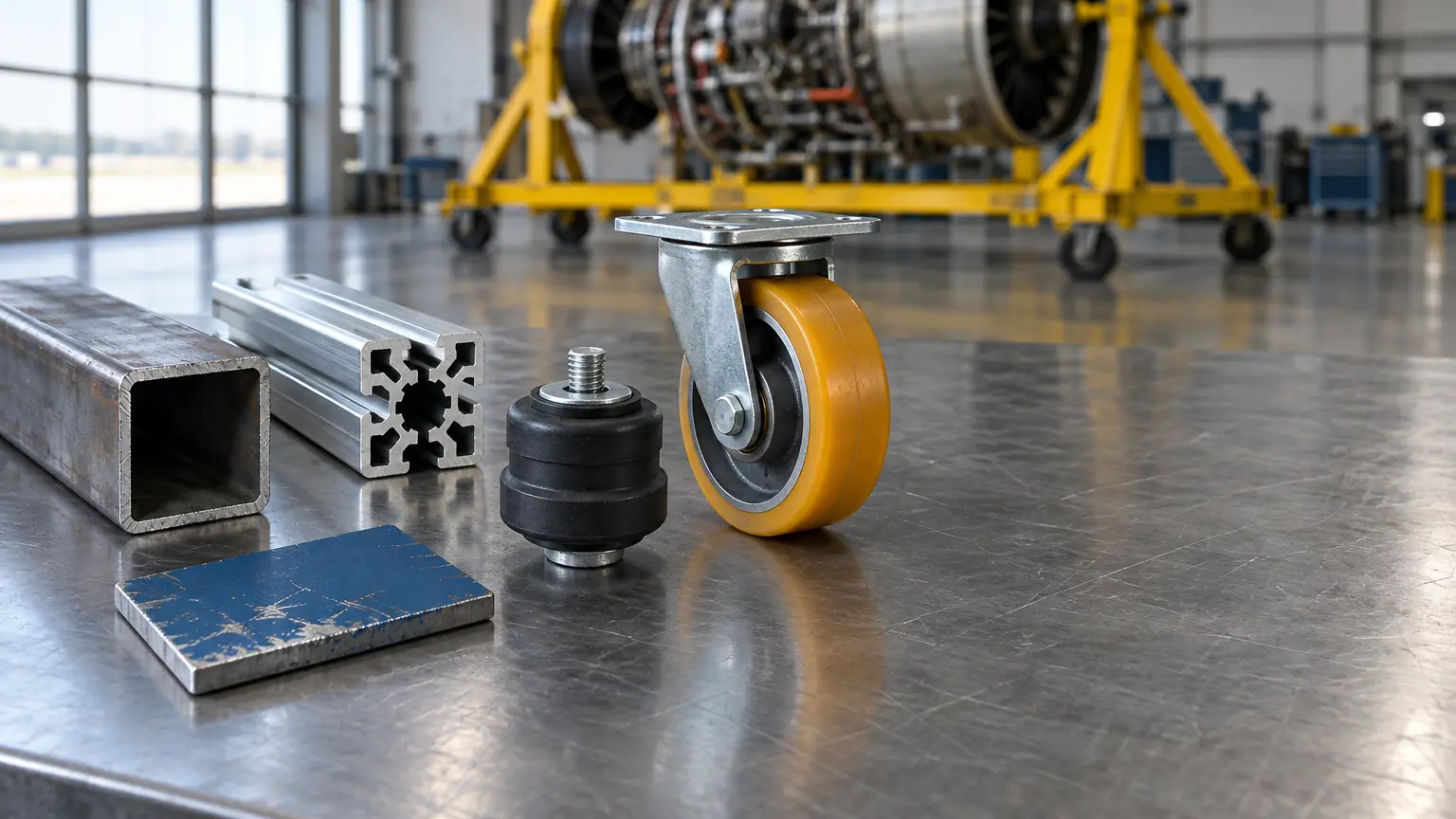
What materials are used in engine stand frames?#
Engine stands must support heavy engines during transport and maintenance. For example, the CFM56-7B stand has a steel welded frame, and the PW1100 stand combines high-strength steel and aluminum. While the PW1500G stand’s data does not list frame material, it is a Pratt & Whitney licensed stand approved for air, sea, rail, and road transport. National Aero Stands rents and leases stands including the PW1500G model.
How does aluminum’s density compare with steel and titanium?#
Aluminum has a specific gravity of 2.7, while iron (a proxy for steel) is 7.9, meaning iron is about three times as dense. Titanium sits at 4.4, about 60 percent heavier than aluminum and 50 percent lighter than stainless steel. These figures, from the FAA’s Aviation Maintenance Technician Handbook, show why aluminum is preferred for aircraft where weight is critical.
| Metal | Specific Gravity (water = 1) |
|---|---|
| Aluminum | 2.7 |
| Titanium | 4.4 |
| Zinc | 7.1 |
| Iron (proxy for steel) | 7.9 |
| Brass | 8.4 |
| Copper | 8.9 |
Source: FAA-H-8083-30B, Chapter 5, Figure 5-1
What does strength-to-weight ratio mean in aviation materials?#
Neither strength nor weight alone is a fair basis for comparing materials; the strength-to-weight ratio is used. Aluminum’s high ratio makes it vital for aircraft structures. Commercially pure aluminum has a tensile strength of about 13,000 psi, but alloying and heat treatment can raise it to 65,000 psi, within the strength range of structural steel.
Why is chrome-moly (4130) steel used for engine mounts and heavily loaded frames?#
Chrome-molybdenum steel, particularly SAE 4130, has largely replaced carbon steel for highly stressed welded structures such as engine mounts and landing gear, according to the FAA Aviation Maintenance Technician Handbook. Heat-treated 4130 tube is approximately four times as strong as a 1025 tube of the same weight and size. Molybdenum raises the ultimate strength without reducing ductility.
How do you prevent galvanic corrosion where aluminum and steel parts meet?#
Galvanic corrosion occurs when two dissimilar metals make electrical contact in the presence of an electrolyte. According to FAA Advisory Circular 43-4B, aluminum alloys and non-stainless steels are in different galvanic groups, making them dissimilar. A small anode next to a large cathode makes attack rapid. Prevention methods include separating the dissimilar metals with insulating materials, protective coatings, or both.

Which coatings help protect steel from corrosion?#
Protective finishes are either sacrificial or non-sacrificial. Sacrificial coatings, which include cadmium, zinc, and aluminum, provide protection by being preferentially corroded. Cadmium plating is used to protect steel parts. A full paint system includes a corrosion-inhibiting primer for adhesion and a durable topcoat for weather and chemical resistance. The EPA limits volatile organic content (VOC) of paints applied to ground support equipment.
Which paints resist Skydrol and other phosphate-ester hydraulic fluids?#
Most commercial transport aircraft use phosphate ester-based hydraulic fluids like Skydrol or Hyjet, which are fire-resistant but can chemically soften thermoplastic resins, oil-based paints, and some other coatings. The FAA Airframe Handbook notes that epoxies and polyurethanes resist these fluids; polyurethane is the standard finish in the aircraft industry. The CFM56-7B stand uses Skydrol enamel coating, and the Trent 700 stand uses Skydrol-resistant paint.
What do shock mounts do on an engine stand?#
Shock mounts are used to isolate equipment from vibration and shock. A general principle is that shock mounts must not be loaded beyond their rated weight capacity. Some engine stands incorporate shock absorption: for example, the PW1100 stand has 8 mounts between the cradle and trolley. The PW1500G stand’s product data does not list shock mounts.
Where can you rent or lease a PW1500G engine stand?#
National Aero Stands, the company behind stands.aero, rents and leases aircraft engine stands to airlines and MROs for short- and long-term use, with an inventory covering CFM56, LEAP-1A/1B, V2500, GE90, Trent 500/700/1000, PW4000, RB211 and JT9D engines from brands including AGSE, DAE, GE and Rolls-Royce. The PW1500G stand, listed at stands.aero/product/pw1500/, is a Pratt & Whitney licensed transportation stand approved for air, sea, rail, and road transport. Pricing is on application, based on duration and pickup location.
| Specification | Value |
|---|---|
| Empty weight | 3,643 lbs (1,652 kg) |
| Length with engine | 158 in (401 cm) |
| Width with engine | 96.75 in (246 cm) |
| Height with engine | 95 in (241 cm) |
| Length without engine | 150 in (381 cm) |
| Width without engine | 90.75 in (231 cm) |
| Height without engine | 47 in (119 cm) |
| Maximum towing speed | 3 MPH (5 KM/H) |
| Transport modes | Air, Sea, Rail, Road |
| Certification | Pratt & Whitney Licensed |
Source: National Aero Stands product data, stands.aero/product/pw1500/