On this page
- What counts as a nickel-based superalloy?
- What are the main nickel-based superalloy families?
- How do alloying elements control high-temperature performance?
- What are the high-temperature failure modes in nickel superalloys?
- How are nickel superalloys heat treated?
- What fabrication considerations apply to nickel superalloys?
- How do you select a nickel superalloy grade for service?
- What are the common nickel superalloy grades and their service envelopes?
- Key takeaways

What counts as a nickel-based superalloy?#
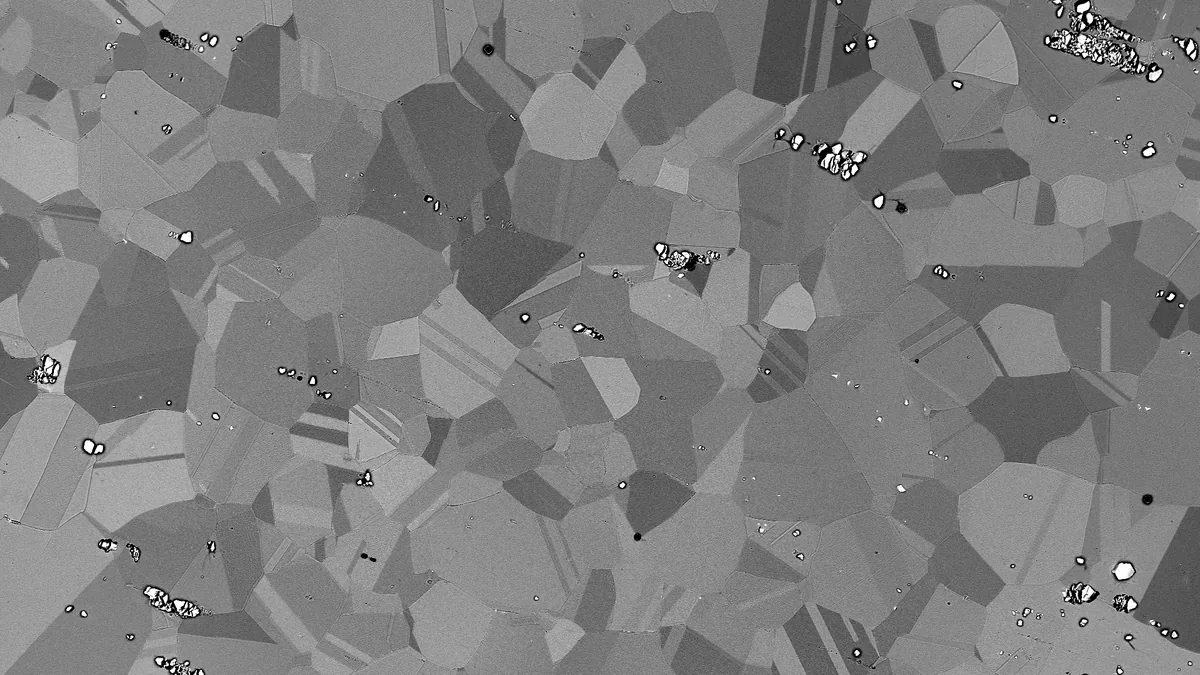
A nickel-based superalloy is a nickel-rich austenitic alloy, typically containing more than 40 percent nickel, that retains useful strength and surface stability during long-term high-temperature exposure. Its face-centered cubic (FCC) matrix provides slower diffusion and more slip systems, giving better creep resistance than ferritic steels.
Within this class there are two broad strengthening approaches. The first is solid-solution strengthening from elements such as chromium, molybdenum, and tungsten in the nickel matrix. The second is precipitation strengthening from ordered phases such as gamma prime, based on Ni3Al or Ni3Ti, and gamma double prime, based on Ni3Nb. Not every nickel alloy is a superalloy. Monel 400, for example, is nickel-copper with excellent corrosion resistance, but it is not normally selected for creep-limited high-temperature structural service.
Wrought and cast forms are both used. The most demanding turbine blades may be directionally solidified or single crystal to eliminate transverse grain boundaries, which are weak in creep and thermal fatigue.
What are the main nickel-based superalloy families?#
The main commercial nickel-based superalloy families are Inconel (nickel-chromium and nickel-chromium-iron), Hastelloy (nickel-molybdenum and nickel-chromium-molybdenum), and Monel (nickel-copper). Beyond these, turbine-grade alloys like Nimonic, Waspaloy, Rene, and single-crystal grades offer higher temperature capability through precipitation strengthening.
Inconel family#
Inconel grades are nickel-chromium or nickel-chromium-iron alloys, often precipitation-hardenable. Inconel 600 (UNS N06600) is a Ni-Cr-Fe solid-solution alloy used in furnace fixtures, chemical equipment, and steam generator tubing. Inconel 625 (UNS N06625) adds molybdenum and niobium for corrosion resistance and solid-solution strength. Inconel 718 (UNS N07718) is the precipitation-hardened niobium-bearing grade for turbine disks, shafts, fasteners, and applications to 650 C. Inconel 601 adds aluminum for oxide scale adherence.
Hastelloy family#
Hastelloy grades are nickel-molybdenum or nickel-chromium-molybdenum alloys optimized for corrosion resistance. Hastelloy C-276 (UNS N10276) is a Ni-Mo-Cr-W grade for severe acid and chloride environments, with useful high-temperature corrosion resistance but not for creep-heavy rotating parts. Hastelloy X (UNS N06002) is a solid-solution Ni-Cr-Fe-Mo gas turbine alloy for combustors, transition liners, and ducting, combining oxidation resistance with fabricability.
Monel family#
Monel 400 (UNS N04400) is a nickel-copper alloy resistant to seawater, reducing acids, and hydrofluoric acid, with an upper service temperature near 480 C; it is not a true high-temperature superalloy. Monel K-500 (UNS N05500) adds aluminum and titanium for age hardening, improving strength for pump shafts, marine fasteners, and valve trim, but its temperature range remains below precipitation-hardened Ni-Cr grades.
Other turbine grades#
Beyond these families, designers use Nimonic 80A, Nimonic 90, Nimonic 105, Waspaloy, Rene 41, Udimet 720, and single-crystal grades such as CMSX-4 for increasing gamma-prime fraction and higher temperature capability. These grades trade weldability, cost, and complexity for higher creep strength in rotating turbine hardware.
How do alloying elements control high-temperature performance?#
High-temperature performance in nickel superalloys is controlled by alloying elements that provide solid-solution strengthening, precipitation hardening, oxidation resistance, and grain-boundary stabilization. Chromium, aluminum, titanium, niobium, cobalt, molybdenum, tungsten, and trace elements like carbon, boron, and zirconium each contribute specific properties that determine creep strength and environmental resistance.
- Chromium forms a protective chromia scale that resists oxidation, sulfidation, and carburization. It also strengthens the solid solution and forms carbides.
- Aluminum forms the ordered gamma-prime phase and also forms alumina scales in some coatings or high-aluminum grades.
- Titanium, niobium, and tantalum form gamma prime or gamma double prime precipitates. They raise strength but can reduce oxidation resistance and weldability if present in excess.
- Cobalt raises the gamma-prime solvus temperature, improves sulfidation resistance, and stabilizes the austenitic matrix in wrought and cast grades.
- Molybdenum and tungsten are strong solid-solution strengtheners. They improve creep resistance and resistance to reducing environments, but too much molybdenum can accelerate oxidation in certain sulfidizing conditions.
- Carbon, boron, and zirconium strengthen grain boundaries. This is critical because grain boundary sliding and cavitation often control high-temperature fracture.
- Iron is present in some grades to reduce cost and improve fabricability. It generally lowers the maximum useful temperature compared with low-iron carbide- and gamma-prime-strengthened grades.
The interaction matters as much as any single element. For example, high aluminum and titanium increase gamma prime volume fraction and high-temperature strength, but they make welding and hot working more difficult. High chromium improves oxidation resistance but can promote sigma or other embrittling intermetallic phases if the composition is not balanced with nickel, cobalt, and molybdenum.
What are the high-temperature failure modes in nickel superalloys?#
Nickel superalloys at high temperature can fail by creep (time-dependent deformation under load), oxidation (surface oxide growth and spallation), hot corrosion (attack by molten sulfate or chloride deposits), thermal fatigue (cyclic strain from temperature gradients), and microstructural instability (coarsening of precipitates). Each mode limits service life depending on temperature, stress, and atmosphere.
At high temperature, a component can fail well below the room-temperature yield strength because the failure mechanisms are time dependent. Creep is slow deformation under constant load. Creep life is often characterized by stress rupture testing and by parameters such as the Larson-Miller parameter, which relates time, temperature, and applied stress on a single plot. For long-life turbine disks and blades, design is usually creep-limited rather than simple tensile-limited.


Oxidation resistance comes from a stable, slow-growing surface oxide. Chromium-rich grades form a chromia oxide, while some high-temperature grades and coatings form a protective alumina oxide. If the oxide spalls during thermal cycling, the surface loses protection and the alloy can begin breakaway oxidation.
Hot corrosion is a more aggressive surface attack involving sulfur, chlorine, or salt deposits. It occurs where combustion gases, seawater salt, or industrial atmospheres produce molten sulfate or chloride films. Alloys with higher chromium and cobalt often perform better in hot corrosion environments.
Thermal fatigue arises from repeated startup and shutdown cycles. Temperature gradients create cyclic strain that can crack thin sections, especially at cooling holes, leading to fatigue failure. For cyclic loading behavior, see Fatigue Failure in Metals: Mechanisms and Prevention.
Microstructural stability is another limit. Gamma-prime or gamma-double-prime precipitates coarsen with time and temperature. If the service temperature is too high for the precipitate, the alloy overages and loses strength. This is why Inconel 718 is generally limited to about 650 C, while Waspaloy or Nimonic 105 can operate at higher temperatures with a more stable gamma-prime structure.
How are nickel superalloys heat treated?#
Heat treatment of nickel superalloys creates and stabilizes the precipitate structure that controls high-temperature strength. Solid-solution grades are solution annealed and quenched; precipitation-hardened grades receive a solution anneal followed by aging to precipitate gamma prime or gamma double prime. Solution temperature and aging time control precipitate size and distribution.
The solution treatment temperature must dissolve the primary strengthening phases without causing excessive grain growth. Aging temperature controls precipitate size and distribution. Under-aging gives lower strength but better ductility. Over-aging coarsens the precipitates and reduces strength. The heat treatment cycle is often specified on the material certificate and must be verified by purchasing and quality personnel. The general thermal cycle logic overlaps with steel heat treatment, but the phases and temperatures are different. See Steel Heat Treatment: Processes, Microstructures, and Properties.
What fabrication considerations apply to nickel superalloys?#
Fabrication of nickel superalloys involves welding, machining, and sometimes powder metallurgy or additive manufacturing. Solid-solution grades like Hastelloy X and Inconel 625 weld more easily, while precipitation-hardened grades like Inconel 718 and Waspaloy require controlled preheat, interpass temperature, and post-weld heat treatment to avoid cracking. Machining is more difficult after age hardening.
Weldability also separates nickel alloy families. Solid-solution grades such as Hastelloy X, Inconel 600, and Inconel 625 generally weld more easily. Precipitation-hardened grades such as Inconel 718, Waspaloy, and Rene 41 may require preheating, controlled interpass temperature, and post-weld heat treatment. In thick sections, they can suffer from strain-age cracking or heat-affected-zone microcracking. Machining is also more difficult after age hardening. For demanding rotating parts, the machining route is often rough machine, heat treat, finish machine.


Powder metallurgy is used for some advanced disk alloys because it yields a fine, uniform grain structure and avoids severe segregation. Additive manufacturing of nickel superalloys is also used for repair and complex hot-section parts, but the same heat treatment and defect-control rules apply.
How do you select a nickel superalloy grade for service?#
Grade selection begins with service conditions: maximum metal temperature, stress state, atmosphere, thermal cycling, and required life. Then match manufacturing route (cast, wrought, welded, machined, or additively manufactured) and check availability in the required product form and specification. Cost and lead time are reviewed after technical requirements are met.
- Determine the maximum metal temperature under load and the required life in hours.
- Determine peak stress, mean stress, and whether loading is steady, cyclic, or thermal-mechanical.
- Identify the atmosphere: air, combustion gas, reducing acid, oxidizing acid, molten salt, or carburizing gas.
- Estimate thermal cycling severity and thermal gradients.
- Decide the manufacturing route: cast, wrought, extruded, welded, machined, or additively manufactured.
- Check availability in the required product form and the relevant ASTM, ASME, or AMS specification.
- Review cost, lead time, and pedigree requirements.
Tensile and stress-rupture certificates are reviewed with the same principles as ordinary mill test reports. See How to Read a Tensile Test Report and Material Data Sheet.
For a rotating turbine disk below 650 C, Inconel 718 is often the first choice because it offers high strength, known fabrication behavior, and wide availability. For a gas turbine combustor liner with moderate stress and high oxidation, Hastelloy X or Inconel 625 may be preferred because they are easier to form and weld. For a chemical plant with reducing acid at lower temperature, Hastelloy C-276 or a similar Ni-Cr-Mo alloy may be the better corrosion choice. For a seawater pump shaft, Monel K-500 may be selected for corrosion and moderate strength, not for high-temperature creep.
What are the common nickel superalloy grades and their service envelopes?#
Common nickel superalloy grades include Inconel 600, 625, 718, Waspaloy, Hastelloy X, Hastelloy C-276, Monel 400, and Monel K-500. Their service envelopes vary: Inconel 718 is used to about 650 C under load, Waspaloy to 870 C, Hastelloy X to 900 C in combustion atmospheres, and Monel grades to about 480 C for corrosion resistance rather than high-temperature creep.
| Grade | UNS | Alloy type | Strengthening route | Typical service temperature envelope | Selection driver |
|---|---|---|---|---|---|
| Inconel 600 | N06600 | Ni-Cr-Fe | Solid solution, carbides | Up to about 1050 C in low-stress oxidizing service | Furnace fixtures, chemical equipment |
| Inconel 625 | N06625 | Ni-Cr-Mo-Nb | Solid solution | Up to about 980 C for light load, lower under high stress | Oxidation plus corrosion resistance |
| Inconel 718 | N07718 | Ni-Cr-Fe-Nb | Precipitation, gamma double prime | Up to about 650 C under load | Turbine disks, shafts, fasteners |
| Waspaloy | N07001 | Ni-Cr-Co-Al-Ti | Precipitation, gamma prime | Up to about 870 C | High-strength rotating parts |
| Hastelloy X | N06002 | Ni-Cr-Fe-Mo | Solid solution | Up to about 900 C in combustion atmospheres | Combustors, ducting |
| Hastelloy C-276 | N10276 | Ni-Mo-Cr-W | Solid solution | Primarily below about 425 C in hot acids | Severe corrosion service |
| Monel 400 | N04400 | Ni-Cu | Solid solution | Up to about 480 C in many environments | Seawater, hydrofluoric acid |
| Monel K-500 | N05500 | Ni-Cu-Al-Ti | Age hardened | Lower high-temperature strength than Ni-Cr grades | Pump shafts, marine fasteners |
Service envelopes are stress dependent. The values in the table are engineering guidelines, not design limits. For a critical part, use the stress-rupture and oxidation data for the exact product form, heat treatment, and grain size specified.
Key takeaways#
- Specify nickel alloys by UNS number and product specification, not by brand name alone.
- Inconel 718 is the standard age-hardened workhorse for parts up to about 650 C.
- For higher temperature turbine parts, select a gamma-prime alloy such as Waspaloy, Nimonic 90, or a modern Rene or single-crystal grade.
- Hastelloy X and Inconel 625 are common solid-solution choices for oxidation-limited combustion and ducting components.
- Hastelloy C-276 and similar Ni-Cr-Mo alloys are selected for chemical plant corrosion, not for creep-heavy high-temperature structure.
- Monel 400 and Monel K-500 are corrosion-focused nickel-copper alloys with lower high-temperature capability.
- Chromium provides oxidation resistance, cobalt improves high-temperature stability, and aluminum, titanium, and niobium create the strengthening precipitates.
- Always define heat treatment, grain size, weld procedure, and inspection requirements for high-temperature service.