On this page
- How does galvanic corrosion develop in mixed-metal assemblies?
- What is the galvanic series and how do you apply it to prevent galvanic corrosion?
- What material selection strategies prevent galvanic corrosion?
- What protective coatings and surface treatments prevent galvanic corrosion?
- What isolation techniques prevent galvanic corrosion in mixed-metal assemblies?
- Which metal couples are most prone to galvanic corrosion and how can you mitigate them?
- What inspection and maintenance routines detect and prevent galvanic corrosion?
- Key takeaways

How does galvanic corrosion develop in mixed-metal assemblies?#
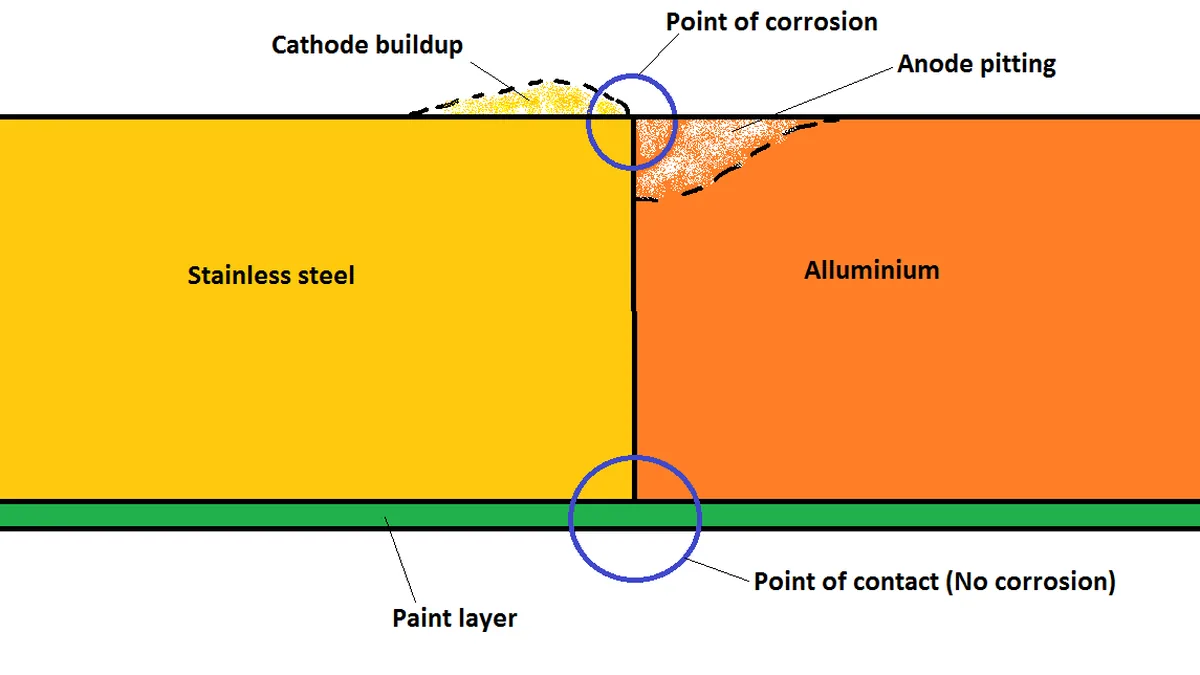
Galvanic corrosion develops when two dissimilar metals are electrically connected in the presence of an electrolyte, creating an electrochemical cell. The more active (anodic) metal corrodes at an accelerated rate, while the more noble (cathodic) metal is protected. The process requires three simultaneous conditions: a potential difference between the metals, direct electrical contact, and an electrolyte bridging both.
Specifically, the three conditions are:
- Two metals or alloys with different electrochemical potentials.
- Direct electrical contact between them (metal‑to‑metal or through a conductive path).
- An electrolyte bridging both metals (water, condensation, soil, process fluid).
When these conditions exist, electron flow from the more negative (anodic) metal to the more positive (cathodic) metal accelerates the dissolution of the anode. The rate depends on the potential difference, the area ratio of cathode to anode, electrolyte conductivity, and temperature. A large cathode area coupled to a small anode is especially dangerous; the anode must supply current to a large surface, speeding its consumption.
Understanding this mechanism clarifies why a bolt of a less noble metal in a large panel of a more noble metal can fail within hours, while the reverse arrangement may last for years.
What is the galvanic series and how do you apply it to prevent galvanic corrosion?#
The galvanic series ranks metals and alloys by their corrosion potential in a specific environment, typically flowing seawater at 25 °C. To prevent galvanic corrosion, select metals that are close together on the series, ideally within 0.15 V of each other. The series shows that active metals like magnesium and zinc are anodic, while noble metals like platinum and graphite are cathodic, guiding material pairing decisions.
Table 1: Abridged Galvanic Series in Seawater (typical potentials vs. Saturated Calomel Electrode)
| Metal / Alloy | Potential (V, approx.) | Activity |
|---|---|---|
| Magnesium | -1.60 to -1.63 | Active (anodic) |
| Zinc | -1.03 | Active |
| Aluminum 1100 | -0.83 | Active |
| Aluminum 6061-T6 | -0.76 | Active |
| Carbon steel | -0.61 | Active |
| Cast iron | -0.61 | Active |
| 304 SS (active) | -0.53 | Active |
| Copper | -0.36 | Intermediate |
| 90-10 Cu-Ni | -0.28 | Intermediate |
| 304 SS (passive) | -0.05 to 0.10 | Noble |
| Titanium | +0.06 | Noble |
| Graphite | +0.30 | Noble |
| Platinum | +0.46 | Cathodic |
Stainless steels appear in two states because they can shift from passive to active if the protective chromium oxide film breaks down. A passive 304 stainless fastener in contact with active 304 material in a crevice will create its own galvanic cell. This dual behavior is why specifying a stainless steel grade alone does not guarantee immunity; the environment determines whether the passive film remains stable. For a deeper dive into alloy differences, see Austenitic vs. Ferritic Stainless Steel: Key Differences.
When selecting metals for a joint, the difference in their seawater potentials is the primary screen. Maintain a potential gap of less than 0.15 V whenever possible. Where exposure is only to fresh water or indoor air, you may relax the limit somewhat because the electrolyte is less conductive, but the series order still applies.
What material selection strategies prevent galvanic corrosion?#
Material selection strategies to prevent galvanic corrosion include pairing metals close together on the galvanic series (within 0.15 V), ensuring the anode has a larger surface area than the cathode, and using replaceable anodic components when mixing is unavoidable. Avoid small anodic fasteners in large cathodic structures, and prefer the same alloy family to minimize potential differences.
Actionable rules for material selection:


- Match metals within 0.15 V of each other in the relevant environment.
- Favor assemblies where the anode has a larger surface area than the cathode.
- When mixing is unavoidable, design the part so the anode is a replaceable component (e.g., a zinc plug or a thick, easily monitored section).
- Prefer the same alloy family; for example, avoid coupling different stainless families (austenitic and martensitic) unless both remain passive.
- In aluminum‑to‑steel joints, consider aluminum alloys with higher corrosion resistance, such as 5052 or 6061-T6. Refer to How to Select the Right Aluminum Alloy for Your Project for assistance in choosing grades that provide a better balance of strength and corrosion behavior.
Alloy quality matters. High‑purity aluminum (1100) is more anodic than copper‑bearing aluminum alloys (2024), so using a more noble aluminum alloy can reduce the driving force slightly. Still, the potential difference with steel remains large, so material selection alone is seldom enough; it must be combined with isolation or coatings.
What protective coatings and surface treatments prevent galvanic corrosion?#
Protective coatings and surface treatments prevent galvanic corrosion by creating a barrier that excludes the electrolyte or by shifting the metal’s potential. Barrier coatings like epoxies isolate both metals; sacrificial coatings like zinc galvanizing protect steel by corroding preferentially. Conversion coatings such as anodizing require sealing to be effective. Coat the cathode, or both metals, to avoid concentrating corrosion at pinholes.
Common coating strategies:
- Barrier coatings (organic paints, epoxies, powder coats): They isolate the metal from the electrolyte. The rule: coat both metals, or at minimum coat the cathodic metal. Coating only the anode concentrates corrosion at pinholes, leading to rapid pitting. If only one side can be coated, coat the cathode to reduce its exposed area and thus the current density on the anode.
- Conversion coatings (anodizing, chromate, phosphating): Anodized aluminum is less active and provides some isolation, but the anodic oxide has crystalline porosity. Sealing the anodized layer (hot water or nickel acetate) is essential to restore barrier properties.
- Metallic coatings (galvanizing, tin plating): A zinc coating on steel (galvanizing) is sacrificial; zinc is anodic to steel and corrodes first, protecting the steel substrate. This is a deliberate galvanic couple that works in the structure’s favor. Tin on steel, however, is cathodic in most environments; once the tin layer is breached, the underlying steel corrodes rapidly.
- Inhibitive treatments: Additives such as chromates in paint primers or molybdates in cooling water systems can passivate surfaces and reduce the galvanic driving force.
For aluminum‑steel connections in outdoor or marine environments, a reliable multi‑layer approach is: anodize the aluminum, seal it, then apply a chromate‑free epoxy primer to both parts before assembly, followed by a joint sealant to exclude moisture.
What isolation techniques prevent galvanic corrosion in mixed-metal assemblies?#
Isolation techniques prevent galvanic corrosion by physically breaking the electrical path between dissimilar metals or excluding the electrolyte from the joint. Electrical isolation uses non-conductive gaskets, washers, bushings, or dielectric unions to interrupt metal-to-metal contact. Electrolyte exclusion employs sealants, drainage design, and continuous welds to keep moisture away from the interface.
Electrical isolation:
- Insert a non‑conductive gasket, washer, or bushing between the dissimilar metals. Materials such as nylon, PTFE, phenolic, or fiber‑reinforced epoxies are common.
- Use insulating sleeves on bolts or rivets to prevent metal‑to‑metal contact through the fastener. A shoulder washer under the bolt head and a flat washer under the nut, both of insulating material, completely break the current path.
- In piping systems, dielectric unions or flange isolation kits (insulating gasket, bolt sleeves, washers) are mandatory when connecting carbon steel to copper or brass.
Electrolyte exclusion:
- Seal joints with polysulfide, silicone, or polyurethane sealants that remain flexible and adhere to both metals.
- Design components to drain water away from the joint. Avoid crevices, horizontal flanges, or pockets where moisture can pool. Provide weep holes.
- Use continuous welds instead of bolted or riveted joints in marine atmospheres to eliminate crevices.
- In electrical enclosures, maintain positive pressure or use desiccant breathers to keep relative humidity below the threshold that supports surface wetness.
A classic field‑proven practice for steel‑to‑aluminum bolted joints is: aluminum washer against the aluminum part, insulated bushing through the hole, steel washer against the steel side, and then a sealing compound over the entire assembly after tightening.
Which metal couples are most prone to galvanic corrosion and how can you mitigate them?#
Common problematic metal couples include aluminum with carbon steel, carbon steel with passive stainless steel, brass with steel, and aluminum with copper. Mitigation strategies involve dielectric isolation, coating the cathode, using sacrificial anodes, or applying non-conductive separators. The table below lists frequent failure cases and straightforward mitigation paths for each couple.
Table 2: Frequently encountered problematic metal couples and recommended actions


| Anode (Corrodes) | Cathode | Typical Failure Environment | Mitigation |
|---|---|---|---|
| Aluminum | Carbon steel | Marine, outdoor with rain | Dielectric isolation, epoxy coating on steel, seal joint |
| Carbon steel | Stainless steel (passive) | Humid or immersed | Coat cathode, avoid small steel fasteners in large SS plate |
| Brass | Steel | Plumbing, seawater | Use dielectric unions, sacrificial zinc anode |
| Zinc (galvanized) | Copper | Roofing runoff, heat exchangers | Avoid copper runs across galvanized surfaces; install non‑conductive separators |
| Aluminum | Copper | Electronics, bus bars | Plate copper with tin or nickel; use isolating washers |
| Magnesium | Any steel or aluminum | Aerospace skins, lightweight structures | Use only with compatible coatings (magnesium must be fully isolated) |
| Graphite / CFRP | Aluminum | Aircraft frames, marine parts | Full isolation with fiberglass ply between CFRP and aluminum, seal edges |
Copper alloys deserve special attention. Brass vs. Bronze: Comparing Copper Alloys for Engineering explains how alloying affects corrosion behavior. Brasses with high zinc content are prone to dezincification, which can be intensified by galvanic coupling to steel. Bronze alloys generally exhibit better resistance, but they are still cathodic to carbon steel and aluminum, so isolation is still required.
What inspection and maintenance routines detect and prevent galvanic corrosion?#
Inspection and maintenance routines for galvanic corrosion include scheduled visual checks for white or red-brown corrosion products at mixed-metal interfaces, verification of insulating washer integrity, and monitoring for loosening of bolted connections. In piping, look for local wall thinning at flanges. Replace sacrificial anodes when they reach 50% of original thickness to maintain protection.
Inspection checklist:
- Look for white, powdery corrosion products on aluminum (aluminum oxide) or red‑brown rust on steel at mixed‑metal interfaces.
- Check for loosening of bolted connections, a sign that the anode has thinned and reduced clamping force.
- Verify that insulating washers and bushings remain intact and have not deformed or cracked.
- Examine paint edge creep around fasteners: if paint is lifting only near the dissimilar metal contact, galvanic activity is underway.
- In piping, look for local wall thinning at flanges with dissimilar materials, often visible as a groove near the gasket face.
- Monitor electrical resistance between isolated parts if the design allows; a drop in resistance indicates moisture bridging or breakdown of insulation.
For assemblies in aggressive environments, incorporate a Quality Inspection Checklist that specifically calls out galvanic corrosion risks. A systematic checklist, such as the one described in Quality Inspection Checklist for Metal Parts, can be adapted to flag mixed‑metal connections for extra scrutiny during receiving or in‑process checks.
Replace sacrificial components on a fixed timetable if field data show they deplete before the next planned outage. A zinc anode that has been consumed to 50% of its original thickness is no longer providing reliable protection.
Key takeaways#
- Galvanic corrosion always requires a potential difference, metallic contact, and an electrolyte; remove one to stop it.
- Use the galvanic series to keep the potential gap below 0.15 V in the service environment.
- A large cathode and small anode is the worst case; avoid it by design.
- Coat the cathode, not just the anode; better yet, coat both metals.
- Physical isolation with insulating gaskets, bushings, or sealants is the most robust long‑term strategy.
- Schedule proper inspection and replace sacrificial elements proactively, not after failure.
- For mixed‑metal assemblies exposed to moisture, a combination of material selection, coating, and isolation almost always outperforms a single method.